Workflow Execution: Major Actors
- Word Count: 245
Major Actor Hierarchy
At the highest level, these are the main actors involved in workflow execution.
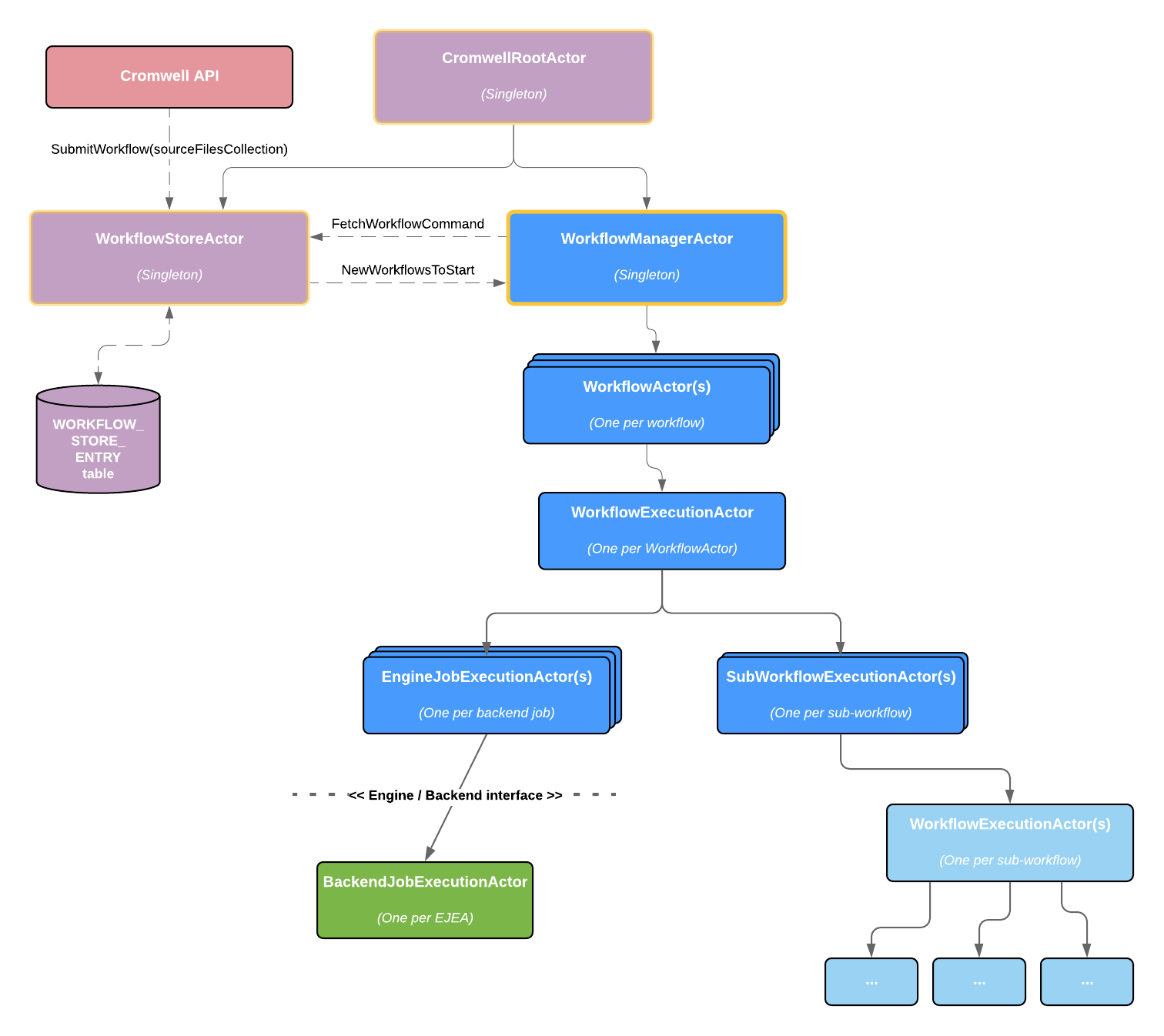
Actors and their Purposes
WorkflowManagerActor
The WorkflowManagerActor is responsible for:
- Polling the
WorkflowStoreat pre-configured intervals. - Starting new workflows
- Tracking, supervising and aborting running workflows
- Parent actor for all
WorkflowActors
WorkflowActor(s)
The WorkflowActor is responsible for:
- Co-ordinating the stages of a workflow lifecycle from parsing through to finalization.
- Parent actor of the
WorkflowExecutionActorwhich runs the workflow's jobs.
WorkflowExecutionActor(s)
The WorkflowExecutionActor is responsible for:
- Starting jobs and sub-workflows as soon as they are able to run.
- Based on values in the (in-memory) ValueStore and ExecutionStore objects.
- Parent actor for all
EngineJobExecutionActors andSubWorkflowExecutionActors.
EngineJobExecutionActor(s)
Each EngineJobExecutionActor (EJEA) is responsible for:
- Running a single job.
- A "job" is a command line instruction to run on a backend.
- Multiple shards for a single call each get their own EJEA.
- Multiple attempts to run the same job operate within the same EJEA
- Respects hog-limiting
- Checks the call cache and job store to avoid running the job if it doesn't have to.
- Triggers job initialization, execution and finalization at appropriate times.
SubWorkflowExecutionActor(s)
Each SubWorkflowExecutionActor is responsible for:
- Running a single sub-workflow.
- Parent actor for a new
WorkflowExecutionActor(see above) created to run the sub-workflow.
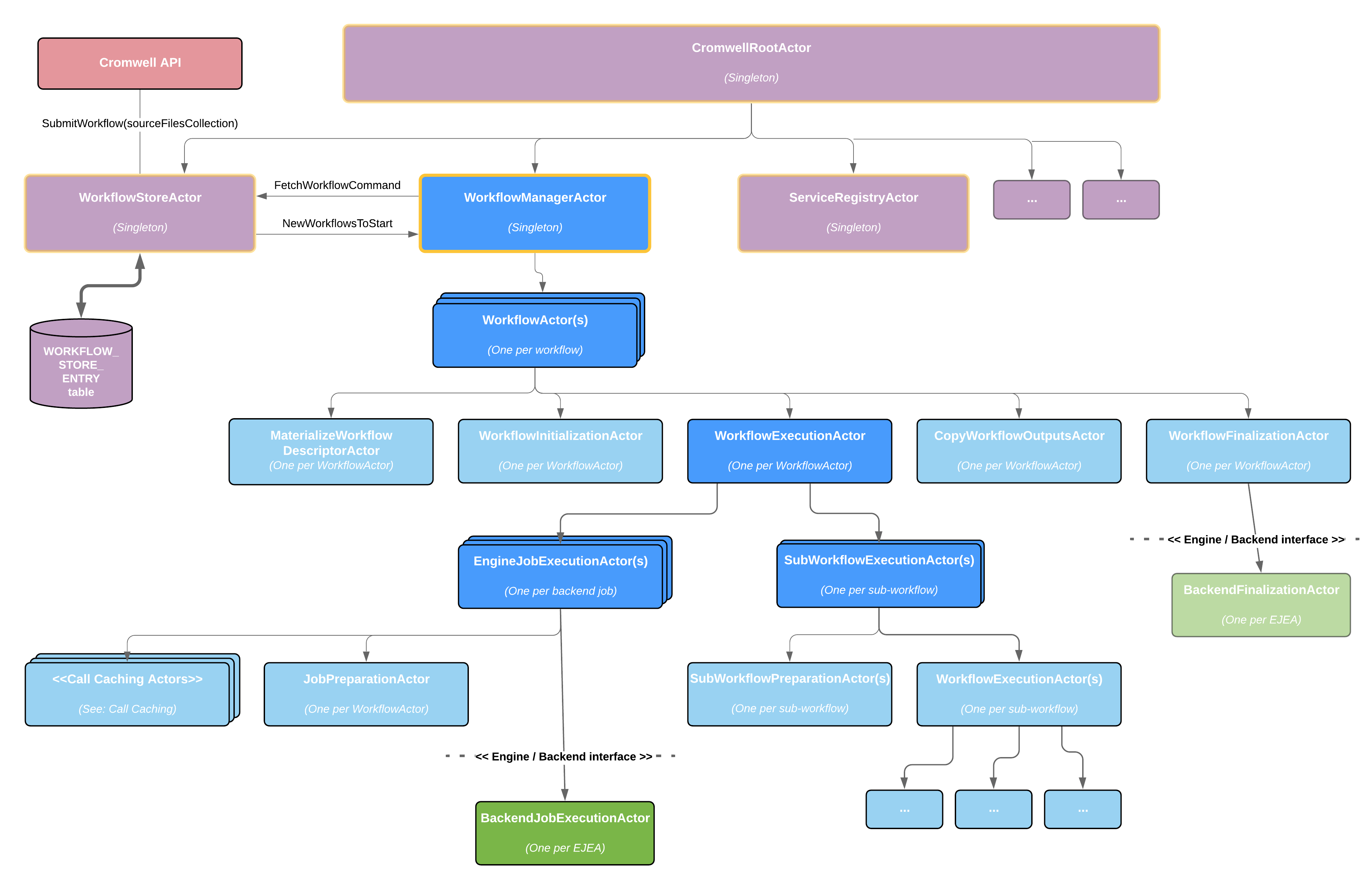
Major Actor Hierarchy (in context)
The above diagram omitted a lot of details. This diagram attempts to show a little more of the context:
See Also
- EngineJobExecutionActor (TODO)
- Backend Execution Actors (TODO)